Featured

Why it’s ok to love Jilly Cooper’s Rivals without writing a searing critique about it

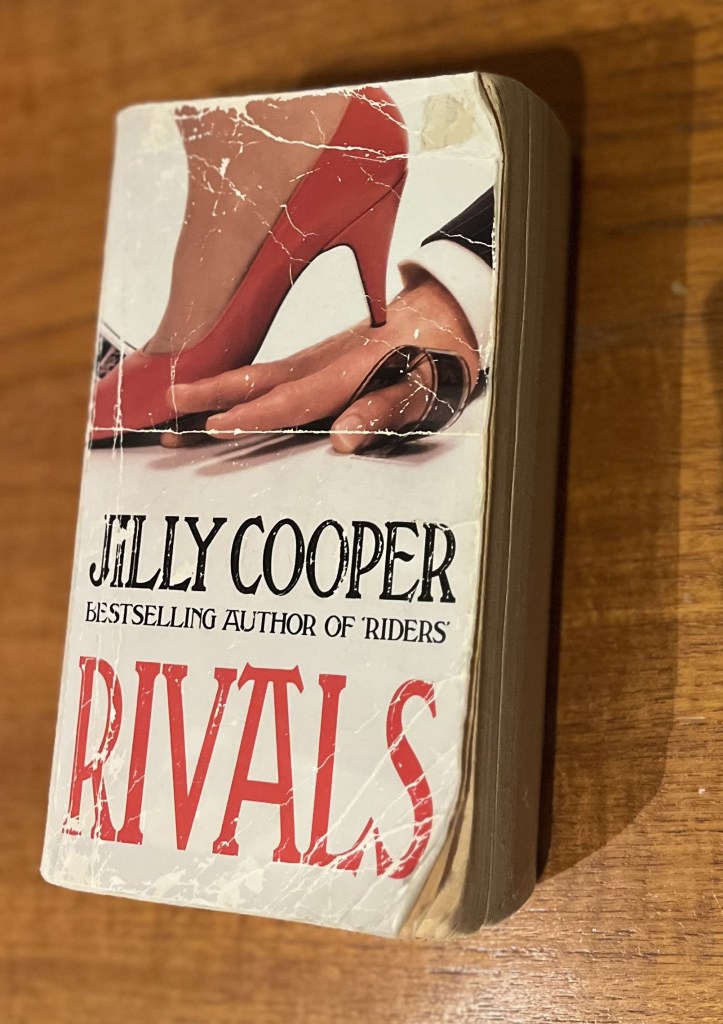
Everybody’s talking about the joy of Rivals, the new Disney+/ Hulu adaptation of Jilly Cooper’s 1986 novel. Commonly described as a ‘bonkbuster’ (posh 80s lingo, darling), the tv adaptation mixes 80’s nostalgia with the thrill of hedonism and a side of ‘how the other half live’ along with a breath-takingly stellar cast. It’s a stonker. It’s also manna from heaven for culture writers who have variously described the show as ‘deeply serious about pleasure’, using watches to see into the characters’ motivations, and being so notable for telling us about life before dating apps.

I’m as big a Jilly Cooper fan as any, ever since I discovered her first book Riders on a bookcase in our holiday gite in Normandy age 14 (much to the dismay of my mother). But I’ve often felt a little embarrassed to admit I’ve read all her books. And while my mother was one of many who once looked down on Jilly Cooper’s writing, now it’s cool – chic, even – to appreciate the show.

Credit: George Ciobra

The question of what is ‘good culture’ has been around for centuries – ever since Joshua Reynolds as Master of the Royal Academy ruled supreme in a world where only art depicting biblical battles (and at a stretch the odd Greek myth – the bloodier the better) could be hung on its walls. But plucky Hogarth didn’t care a jot, and he pressed ahead with his beautiful portrait of the lowly little shrimp girl and his socially searching and often disgusting satires Marriage a la Mode and the Rake’s Progress. Now these paintings can be seen in the National Gallery because ‘high art’ and ‘low art’ have an annoying habit of blurring their boundaries, and sometimes it’s hard to keep track of what is high and what is low. And it takes a masters in art itself – or maybe in reading Tatler – to know what is currently good taste and what is not.

But appreciating culture for what it says about society and actually enjoying it are two different things – remember Vivian crying in the opera in Pretty Women or Eliza Dolittle screaming at the horses in My Fair Lady? In their unconditioned wonder of opera and horseracing, they showed that it’s fine to love something just for the thrill of it. That is why it is important that kids learn to play the violin in Year 3, that they learn about the Greek gods, or visit a gallery and sketch a painting. And why they also need to go to laser quest, ride the flumes at the water park and be a pinball wizard on Brighton pier. Art and culture is a means of expression but it primarily exists to make our lives more enjoyable and to bring us pleasure.

The main reason why my love for Jilly Cooper is so enduring is because it offers first class escapism: I can turn my brain off and enjoy it for the hell of it. To make it worthy or a searing critique about society would be to lose all its joy. Everyone acting in Rivals looks like they’re having a blast. I’m having a blast watching it. And that is why the show has been so brilliantly successful.

November 2024

So long Topshop… from a 90s teen

It’s been on the cards for almost a year, when owner Arcadia called in an advisor to broker an urgent deal with landlords. Since then, we’ve seen the end of retailers who have been around for longer and held a stronger place in the national consciousness. Even John Lewis has struggled in recent months. So the fall of Topshop, a largely store-based empire at a time of dominant (and, since covid, necessary) digital commerce, is not a surprise. Next week Arcadia is due to be broken up with a potential buyer set to ‘pick over the pieces’ like a vulture devouring a rotting carcass.

For a particular generation, the will-o-the wisp floral skirt and DM-wearing 1990s teen, the demise of Topshop feels particularly sad.

I discovered Topshop when I was growing up in Croydon in the 1990s. In the heart of the once glorious Whitgift Centre, it felt like a pass to freedom. Rails of cheap jumpers and rainbows of little dresses. It was an opportunity for self-expression in the way I dressed and the choices I made for myself. Me and my also-slightly nerdy friends loved nothing more than an idle Saturday afternoon running our hands through racks of ribbed t-shirts and button-down denim skirts before stopping off at the Body Shop for a dewberry body spray.

I’ll never forget the day I first made it to the Topshop store in Oxford Street, standing at the entrance like a pilgrim on the steps of the Sacre Coeur. It was the first time me and my friends were allowed up to London on the train from East Croydon, so of course we headed straight there. The rush of adrenalin was almost spiritual when I found a beautifully flippy wraparound satin skirt to wear to my first proper New Year’s Eve party. As I paid my £25 at the gleaming white till, I was in hoc to the possibilities it conjured up, like a ticket to the glamour of the big city. It was a sensation I’d never felt before. And it was enticing.

Topshop continued to play a large role in my life. I have a number of beloved items from that place over the years: my navy cape with the rust satin lining; an indigo blue skirt that seems to work in any given situation; the yellow duck-print socks that I wore through countless ballet rehearsals until holes appeared in the heels; and a midi skirt with orange flowers that strangers still stop me in the street to compliment. Thousands of jumpers, jeans and, well, tops.

Me in some Topshop attire, Paris.

There was a reason I always loved Topshop. The clothes were not tarty, not compromising, they were pretty but somehow empowering. They came up small at times, but they did not come up short. The quality was generally good and the clothes were practical and long lasting. And no matter how many times you visited, you seemed almost guaranteed to come away with something worth buying.

In recent years that changed. I found myself disappointed as I searched the Topshop website while balancing a small baby on my lap. I have changed. With two small children, I’m not in the market for short skirts and spaghetti straps anymore. But it’s not just me. In the past, Topshop had a knack for churning out timeless, inventive and stylish pieces often with a foothold in 20th century fashion history. Nowadays the products are all short, long splits and crop tops. Not the kind of thing you can wear to nip down to the shops. Not appropriate for work. Definitely not flattering if you’re not 18 anymore.

Some people have pointed to the departure of head stylist Kate Phelan in 2017 as the turning point for the store. There was a half-hearted attempt to compete with the cut price fashion of BooHoo and friends. The clothes seemed targeted at Topshop’s ‘core’ student market, but arguably only for some of them. The fashion too often fell into the faddy category. It became harder to find anything out-standing or particularly beautiful. I started to notice that, when I did make a purchase, it fit badly, arrived crumpled, or differed from the pictures on the screen – although customer service was always very good. I would still look at the site from time to time, sometimes with a pang of longing for times gone past, but I rarely bought.

Last year, allegations of Philip Green’s behaviour came out. He has been accused of harassment of a number of Arcadia employees. There was an unsavoury incident where he demanded the removal of a stall selling the popular feminist book ‘Feminists don’t wear pink’, minutes before the Oxford Street flagship store was due to open with the stall all ready to go, front and centre. After this, browsing the Topshop website seemed a little distasteful. Did I want to line the pockets of this man? His morals seemed to go against the ones that Topshop had embodied to me.

I don’t think that I’m the only old-timer Topshop customer who feels this way. The spirit has already gone from the Topshop phenomenon. On one hand, Topshop has fallen behind online retail leaders who approach digital content in a campaign-led way. On the other, they’ve failed to keep up with the move away from fast fashion towards ethically-sourced investment pieces with design-integrity at their heart. There’s hope that Topshop in some shape or form will live to see another day (although who knows how many jobs will be saved). BooHoo may pick up the pieces as it has with Warehouse and Karen Millen. But, judging by their approach to Black Friday, that might mean a sad and slightly inevitable slide in the wrong direction.

I will look back on my 1990s Topshop with fond memories. But that Topshop is already gone, consigned to the archive and the attic.