Featured

Why it’s ok to love Jilly Cooper’s Rivals without writing a searing critique about it

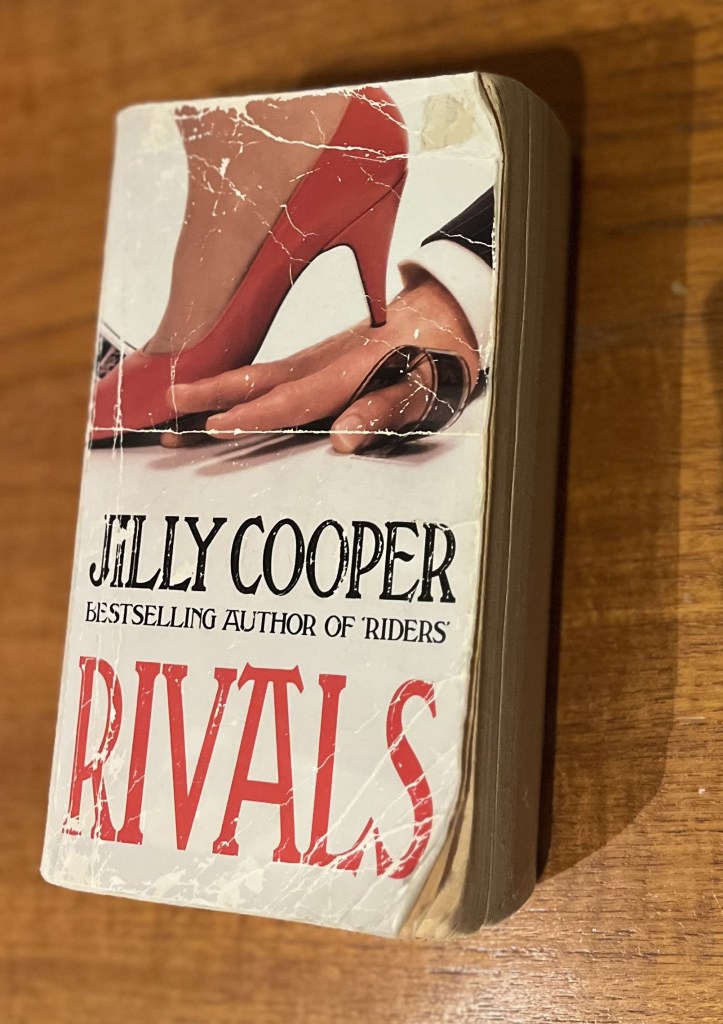
Everybody’s talking about the joy of Rivals, the new Disney+/ Hulu adaptation of Jilly Cooper’s 1986 novel. Commonly described as a ‘bonkbuster’ (posh 80s lingo, darling), the tv adaptation mixes 80’s nostalgia with the thrill of hedonism and a side of ‘how the other half live’ along with a breath-takingly stellar cast. It’s a stonker. It’s also manna from heaven for culture writers who have variously described the show as ‘deeply serious about pleasure’, using watches to see into the characters’ motivations, and being so notable for telling us about life before dating apps.

I’m as big a Jilly Cooper fan as any, ever since I discovered her first book Riders on a bookcase in our holiday gite in Normandy age 14 (much to the dismay of my mother). But I’ve often felt a little embarrassed to admit I’ve read all her books. And while my mother was one of many who once looked down on Jilly Cooper’s writing, now it’s cool – chic, even – to appreciate the show.

Credit: George Ciobra

The question of what is ‘good culture’ has been around for centuries – ever since Joshua Reynolds as Master of the Royal Academy ruled supreme in a world where only art depicting biblical battles (and at a stretch the odd Greek myth – the bloodier the better) could be hung on its walls. But plucky Hogarth didn’t care a jot, and he pressed ahead with his beautiful portrait of the lowly little shrimp girl and his socially searching and often disgusting satires Marriage a la Mode and the Rake’s Progress. Now these paintings can be seen in the National Gallery because ‘high art’ and ‘low art’ have an annoying habit of blurring their boundaries, and sometimes it’s hard to keep track of what is high and what is low. And it takes a masters in art itself – or maybe in reading Tatler – to know what is currently good taste and what is not.

But appreciating culture for what it says about society and actually enjoying it are two different things – remember Vivian crying in the opera in Pretty Women or Eliza Dolittle screaming at the horses in My Fair Lady? In their unconditioned wonder of opera and horseracing, they showed that it’s fine to love something just for the thrill of it. That is why it is important that kids learn to play the violin in Year 3, that they learn about the Greek gods, or visit a gallery and sketch a painting. And why they also need to go to laser quest, ride the flumes at the water park and be a pinball wizard on Brighton pier. Art and culture is a means of expression but it primarily exists to make our lives more enjoyable and to bring us pleasure.

The main reason why my love for Jilly Cooper is so enduring is because it offers first class escapism: I can turn my brain off and enjoy it for the hell of it. To make it worthy or a searing critique about society would be to lose all its joy. Everyone acting in Rivals looks like they’re having a blast. I’m having a blast watching it. And that is why the show has been so brilliantly successful.

November 2024
Featured

What is creativity and original thought?

What does it mean to be truly original? Is any thought actually an original one? How creativity is made up of layers of thought built up throughout human history..

Credit: Florian Klauer

At university we were told we had to sift through and assess sources, review the arguments made by historians and come up with our own analysis to impress the examiner. The best students were the ones who challenged the question and came up with an original interpretation of the subject whilst also displaying knowledge of the area and style in constructing their arguments. I soon discovered that I was quite bad at all these things, and the more I struggled through dusty books in the university library and drowned in piles of notes, the worse I got. How could I, an innocent 18 year old, compete with millennia of withered historians who’d spent lifetimes becoming experts on their subjects? ‘I just lack the capacity of original thought.’ I said to a friend, who thought it was hilarious.

Later on, I was starting off in a communications consultancy and enjoying the adrenaline of pitching for client accounts when a new director came in and sat us round the table as we tried to brainstorm slogans, ideas, and campaigns for everything from medical stents to nuclear power stations. ‘He wants to find out who is creative,’ one of my colleagues told me, ‘He wrote a book on creativity.’

Creativity is such a nebulous and subjective subject, it seemed crazy that anyone would be qualified to comment on another person’s creative ability based on a couple of conversations. It made me wonder whether creativity is an inherent quality a person has or something that you can develop over time. Also, in the 300,000 years of human existence, with storytelling an inherent part of human life since homo sapiens came on the scene, is there the scope for anything new? They say there are only seven stories that are told, and that all the novels, plays, soap operas, Netflix series that have been produced are merely reinterpretations of them. A depressing thought for an aspiring writer, maybe. But is that a problem?

‘Creative thinking for adapting an original idea to a real-life setting enables human beings to create civilizations different from other animal worlds’

Park et al (2016) from Neuro-Scientific Studies of Creativity

Sociologists think that creativity has been both a key factor in human survival and indicative of a level of higher thinking that humans can access most easily when their basic needs are met. Scientists have been fascinated by the role of creativity in differentiating humans from other creatures.

Credit: Julia Joppien

But does creativity mean complete originality? 

Once I got over my unfortunate incapacity for original thought, I thrived in the creatively driven agency world. I learnt to scan around for ideas that are clever, that already work, drawing different ideas and concepts together to mold and shape them until they don’t look anything like the original. 

During this time, I realised that the fuel and confidence for creativity comes by drawing inspiration from other people’s work. When I write, I no longer beat myself up for drawing concepts and style from authors I have read (whilst obviously not ripping them off, this is not an endorsement of plagiarism!). As well as giving me an excuse to indulge my lifelong passion for reading, it’s given me the freedom to develop my own ideas and style, whilst not repeatedly hitting a roadblock of introspection, the fear that, in the whole world of thinking, my tiny contribution is surely destined to evaporate unseen. Once I gave up my hang-up about not coming up with the most original writing, it freed me up to enjoy what I do. When I write in my boss’s style, I feel my writing is better, more interesting, more colourful than when I write just as ‘me’. It’s nice to play at being another person, and in fact I feel freer to take risks and be more playful in my writing (as she, a brilliant writer, is herself). Freeing the brain from its barriers gives me a different kind of confidence.

Credit: Janko Ferlic

So, can I cheat and say that creativity doesn’t necessarily mean true originality? Is originality really a myth? That might be stretching it too far, and I’m probably not qualified to speculate on whether original thought actually exists. But I have a feeling that a happy compromise of the reimagining and blending of thousands of ideas will keep creativity alive for as long as humanity needs it. 

July 2024

Does a novel from 2018 have the answer to lockdown?

I spoke to Georgia Greaves on My Year of Rest and Relaxation by Ottessa Moshfegh

Georgia chats to me over Zoom

I read this book in January, about a wealthy New Yorker who decides to hide away from the world in her Upper East Side apartment sleeping for days at a time on a cocktail of infermiterol, ativan, and neuroproxin.

Back then, the concept of holing up in your house for several months seemed quaint. Something that might have happened in a previous generation perhaps, but would be impossible in our hyper-connected world. It was the perverse attraction of the idea of pulling down the shutters and pulling the duvet over my head that made the book intriguing to me. Three months on, of course, the book is eerily prescient. A prediction of a situation that not one girl alone in a city but almost every individual across the world would be forced into in a matter of weeks. 

So, it felt like a good time to talk it through with my fellow bookworm and Louis XIV scholar Georgia Greaves. When we caught up over Zoom, Georgia had just finished moving her library of books from Sheffield to London and was unloading it onto a bookshelf decorated with fairy lights and succulents planted in little clay pots. 

Turning the book over in her hands, Georgia says the story has her given her plenty to think about during the mandatory confinement.

‘Even though the protagonist’s confinement is self-imposed, there are passages that resonate with our current situation.’

She thumbs through the pages to read me a passage:

‘”the days are slipping into one, not sure what’s sleep and what’s reality. During this lull in the drama of sleep. Sleeping, walking, it all collided into one grey monotonous plane ride through the clouds.”’

A lot makes sense here in our current situation. We’ve lost our normal framework of life which over the days and weeks affects our concept of time passing, and as our connection to the outside world is diluted, the line is blurred between dream and reality.

‘She knows she wants to have this year to fall asleep and she knows she’s going to emerge from the other end. That is the same for us, we know it’s just temporary,’ Georgia says. ‘Although, unlike us, she’s imposed it on herself, it’s still the same, we’re just passing the time until it changes and we can go outside again.’

‘On a less obvious note, this is all about how she’s coping with her life. Her mechanism is through sleep, what she believes is going to get her through difficult periods in her life. It isn’t the route most people would go down, but it seems to work for her at the end. This is what a lot of us are doing at the moment.’

The book is set in 2001, ending just after 9/11 so that the plot covers the protagonist’s life before the tragedy (rather than after it, as is usually the case with 9/11 literature). The narrative is handled carefully, so the reader gets swept along by the absorption of the protagonist in the minutia of their life and the arrival of 9/11 comes as a surprise as much to us as to her.

‘It’s strange that a book about that disaster isn’t really about that at all.’ Georgia continues, flipping through a neat row of post-it notes marking moments in the book. ‘It’s just ultimately just a fact of life at the end of the book… even then it’s told in a very matter of fact manner. Almost an uncommon reaction… I ask myself is it actually about the twin towers, did she set out to write about it? Or is it a message about people sleepwalking through life until a really big thing happens?’ 

There’s another lesson here, Georgia explains. In her rare trips out to the local corner shop, the main character glances at events splashed across the magazines and newspapers – Bush versus Gore, Californian wild fires, earthquake in South East Asia. 

‘It’s very strange that a lot of these events also happened in the last year,’ she says. ‘Is this a comment that we read these headlines and think it’s bad but nothing really affects us, and then it just happens again, still sleepwalking? It’s the same now with the news articles about covid 19. There was more shock at the start of it. Now there are 600 deaths a day, we can easily slip into feeling detached and numb to it. It’s not a shock anymore. That’s very revealing about human nature. Does this exposure make us more complacent?’ 

The book is complex and has a deep, and sometimes disturbing, story about friendship at its heart. The protagonist herself is emotionally stunted, cruel and guilty of all conformity and neediness that she despises in other people. She takes desperate steps to cleanse herself of her ills and there’s a sense of bitter-sweet rebirth in the ending. Will we as a society be able to affect our own rebirth and emerge from lockdown with the same sense of renewal? I have my doubts but, in the absence of any certainty, we can take heart from the message in My Year of Rest and Relaxation and have hope.