How to behave in public (What ballet has taught me about life)

Photo by Hannah Busing on Unsplash

On a recent Saturday night at the Royal Opera House, the audience was looking forward to the ballet Different Drummer; a serious work by one of the twentieth century’s most influential choreographers, Kenneth MacMillan. The ballet, based on the German drama Woyzeck, builds to a tense moment when the girlfriend of the main character, the tragic soldier, is lured away by another man. On this night, just when the girlfriend turned away from Woyzeck to look longingly back at her new suitor, the music was interrupted by the sound of shattering glass from the upper slips – the very furthest away seats to the top and side of the auditorium. A slow handclap was followed by scuffles and protests, as someone tried to intervene with whoever it was who was making a ruckus. The protests began quietly at first – as people started to crane irritably away from the performance to see what was going on – before getting louder and finally a scream ‘I just want to enjoy the f–king music!’, before the poor man was ushered out of the room and the drama, off stage at least, was over.

You do hear about audience behaviour taking a nosedive in the West End, but this almost never happens in ballet. It would have been a shock at any ballet performance to have the audience convention of silence broken in such a forceful and unexpected way. But coming at such a tense point in a dark and soul-wrenching ballet, the moment was heightened and the uncertainty about what might prevail was quite disconcerting – as if what was happening on and off stage were somehow weaving themselves together. After the show, the audience chatted amongst themselves in anxious voices, and tones of awe, about how shocking the outburst had been and what could have been done by Opera House management to prevent such a situation escalating. They carried on discussing it in taxis, on the tube and on online forums.  

Photo by Hulki Okan Tabak on Unsplash

The incident made me reflect that we live in a world where in public at least we are to behave in certain ways. You don’t even think about these conventions being there, until they are broken. The shock of someone breaking that convention at the ballet rippled through the audience in a tangible way, almost lending itself to a thrill. We are often told that, in Shakespeare’s day, the audience would heckle, carry on conversations and throw fruit (although they haven’t reintroduced this at the Globe..); and Edith Wharton’s accounts of high society in turn of the century Manhattan pivot around the great and the good carrying on their socialising in their expensive opera boxes while the performance was going on down on the stage. But this is not the norm or the expectation nowadays.

There are practical reasons for people to be silent, and for large groups of people to behave in a certain way so that order can prevail, and events can proceed as planned. But at the same time, the almost salacious shock at the interruption of Different Drummer suggests that these social conventions take on more than a pragmatic purpose. In 1903, a sociologist called George Simmel spoke about the ‘impulse to sociability’ where humans have an instinct to behave in a way that is socially acceptable and enables them to belong to a particular group – or society in general. It’s a concept that has often been used derogatively, for instance in inferring that people don’t think for themselves and blindly follow fashions and trends without exerting their own creativity. But actually, we all have good reasons to conform, even if it means giving up some of our individual autonomy from time to time.
Photo by Abigail Lynn on Unsplash

Non-conformity can be powerful and can used as protest to demonstrate disagreement or dissent about something that is happening. A famous example was when musician Jarvis Cocker stormed the stage of the Brit Awards in 1996 to show his disgust at Michael Jackson performing a very self-reverential song, dressed as a Christ-like figure. Cocker mounted the stage and shook his bum at the audience – hundreds of thousands of people watching the awards on live TV. Cocker got away with it, largely because many people agreed with him even though they wouldn’t have dreamt of doing it themselves, and there was something in his personality and credibility that allowed him to carry it off. Cocker presumably calculated that he had nothing to lose by getting onto the stage, and it proved to be the case, as shown by his continuing success and popularity over the next twenty years. Going further, there are occasions when groups of people actually rebel against conventional behaviour as a herd. The documentary Woodstock 99 shows a wide-scale loss of order after festival goers endured terrible conditions including the lack of food and water, unbearable heat, and ground saturated by sewage. After three days of this, the crowd erupted in a riot, destructing the temporary structure that had been set up for the festivals, setting fires, rape and pillage. The mass momentum to act like this was prompted by a breakdown in the social contract made by the festival organisers to the people who had paid to attend, in turn triggering the festival goers to forsake social norms en masse. The chaos was only brought to a close with the arrival of a large consignment of the national guard.

Van Kleef, Wanders, Stamkou and Homan is a review of research and literature around norm violation and plots out a model of factors that influence norm violation and our responses to it. They point out that minor norm violations such as leaving the remains of your lunch on the table and interrupting each other during conversations are ‘omnipresent’. They looked into the factors which make ‘rule breaking’ of this nature more likely and found two factors which influence whether people violate norms. One factor is that people are more likely to violate norms when they perceive others also break the rules – which may account for the festival goers at Woodstock rioting in response to being let down by the festival organisers. The article says that in these cases ‘societal level norms about how one ought to behave may be overruled by local norms that are constructed based on the perceived behaviour of others in one’s social environment.’  The other factor is that people who feel more powerful in a situation are more likely to break norms. In other words, Jarvis Cocker is unlikely to have stormed the stage at the Brit awards if he had been a waiter serving drinks or a member of public who just happened to have a ticket.

The third point in the article is the impact that norm violation can have on other people. The study finds that norm violations trigger feelings of anger, blame, anxiety and fear, even when no personal harm is involved. What’s more, ‘ingroup deviants’ (ie people who are part of a group or society where those norms are established) are regarded more harshly than ‘outgroup deviants’. This can explain the disgust and shock of the members of audience who, after the performance, could only discuss the behaviour of the gentleman at the ballet. Van Kleef, Wanders, Stamkou and Homan say that gossip has been found to foster norm compliance as people endorse the violation of certain norms to defend other norms that are seen as more important. The need to discuss and condemn the behaviour of that particular member of the audience was a way of reinforcing the norms of that group – ie regular attendees of the ballet – and perhaps even the bonds between members of that group as people who are committed to appreciating ballet as an art form.

May 2024

So long Topshop… from a 90s teen

It’s been on the cards for almost a year, when owner Arcadia called in an advisor to broker an urgent deal with landlords. Since then, we’ve seen the end of retailers who have been around for longer and held a stronger place in the national consciousness. Even John Lewis has struggled in recent months. So the fall of Topshop, a largely store-based empire at a time of dominant (and, since covid, necessary) digital commerce, is not a surprise. Next week Arcadia is due to be broken up with a potential buyer set to ‘pick over the pieces’ like a vulture devouring a rotting carcass.

For a particular generation, the will-o-the wisp floral skirt and DM-wearing 1990s teen, the demise of Topshop feels particularly sad.

I discovered Topshop when I was growing up in Croydon in the 1990s. In the heart of the once glorious Whitgift Centre, it felt like a pass to freedom. Rails of cheap jumpers and rainbows of little dresses. It was an opportunity for self-expression in the way I dressed and the choices I made for myself. Me and my also-slightly nerdy friends loved nothing more than an idle Saturday afternoon running our hands through racks of ribbed t-shirts and button-down denim skirts before stopping off at the Body Shop for a dewberry body spray.

I’ll never forget the day I first made it to the Topshop store in Oxford Street, standing at the entrance like a pilgrim on the steps of the Sacre Coeur. It was the first time me and my friends were allowed up to London on the train from East Croydon, so of course we headed straight there. The rush of adrenalin was almost spiritual when I found a beautifully flippy wraparound satin skirt to wear to my first proper New Year’s Eve party. As I paid my £25 at the gleaming white till, I was in hoc to the possibilities it conjured up, like a ticket to the glamour of the big city. It was a sensation I’d never felt before. And it was enticing.

Topshop continued to play a large role in my life. I have a number of beloved items from that place over the years: my navy cape with the rust satin lining; an indigo blue skirt that seems to work in any given situation; the yellow duck-print socks that I wore through countless ballet rehearsals until holes appeared in the heels; and a midi skirt with orange flowers that strangers still stop me in the street to compliment. Thousands of jumpers, jeans and, well, tops.

Me in some Topshop attire, Paris.

There was a reason I always loved Topshop. The clothes were not tarty, not compromising, they were pretty but somehow empowering. They came up small at times, but they did not come up short. The quality was generally good and the clothes were practical and long lasting. And no matter how many times you visited, you seemed almost guaranteed to come away with something worth buying.

In recent years that changed. I found myself disappointed as I searched the Topshop website while balancing a small baby on my lap. I have changed. With two small children, I’m not in the market for short skirts and spaghetti straps anymore. But it’s not just me. In the past, Topshop had a knack for churning out timeless, inventive and stylish pieces often with a foothold in 20th century fashion history. Nowadays the products are all short, long splits and crop tops. Not the kind of thing you can wear to nip down to the shops. Not appropriate for work. Definitely not flattering if you’re not 18 anymore.

Some people have pointed to the departure of head stylist Kate Phelan in 2017 as the turning point for the store. There was a half-hearted attempt to compete with the cut price fashion of BooHoo and friends. The clothes seemed targeted at Topshop’s ‘core’ student market, but arguably only for some of them. The fashion too often fell into the faddy category. It became harder to find anything out-standing or particularly beautiful. I started to notice that, when I did make a purchase, it fit badly, arrived crumpled, or differed from the pictures on the screen – although customer service was always very good. I would still look at the site from time to time, sometimes with a pang of longing for times gone past, but I rarely bought.

Last year, allegations of Philip Green’s behaviour came out. He has been accused of harassment of a number of Arcadia employees. There was an unsavoury incident where he demanded the removal of a stall selling the popular feminist book ‘Feminists don’t wear pink’, minutes before the Oxford Street flagship store was due to open with the stall all ready to go, front and centre. After this, browsing the Topshop website seemed a little distasteful. Did I want to line the pockets of this man? His morals seemed to go against the ones that Topshop had embodied to me.

I don’t think that I’m the only old-timer Topshop customer who feels this way. The spirit has already gone from the Topshop phenomenon. On one hand, Topshop has fallen behind online retail leaders who approach digital content in a campaign-led way. On the other, they’ve failed to keep up with the move away from fast fashion towards ethically-sourced investment pieces with design-integrity at their heart. There’s hope that Topshop in some shape or form will live to see another day (although who knows how many jobs will be saved). BooHoo may pick up the pieces as it has with Warehouse and Karen Millen. But, judging by their approach to Black Friday, that might mean a sad and slightly inevitable slide in the wrong direction.

I will look back on my 1990s Topshop with fond memories. But that Topshop is already gone, consigned to the archive and the attic.  

Why politics needs comedy in a time of crisis

A ray of sunshine and a political lifeline – my take on the breakout TikTok stars of the Covid-19 crisis

When the Covid crisis escalated in the UK and it became clear that we needed to lock down and fast, we all turned to the government and, in particular, Boris Johnson for direction. We were prepared to put aside months and years of Brexit-fuelled political turmoil, if he could provide leadership, instruction and reassurance at a frankly scary time.

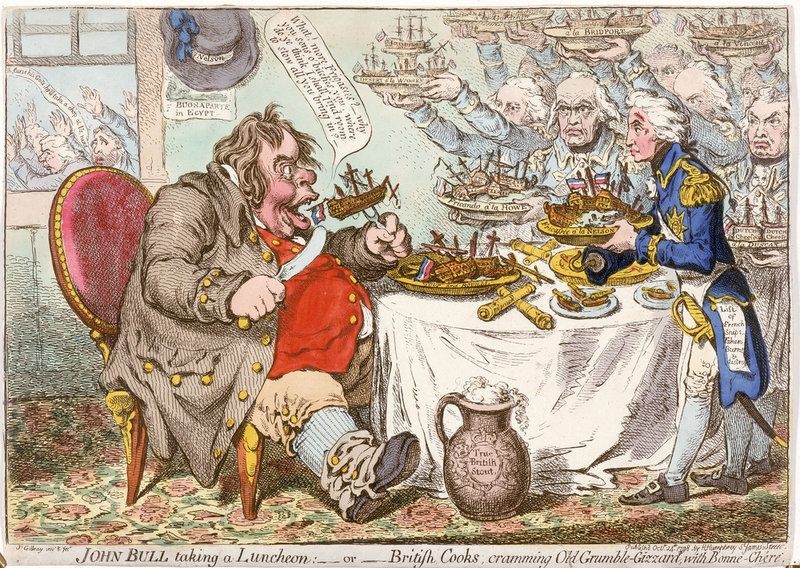
John Bull taking a Luncheon – James Gillray, 1798

A few months down the line, things look different. We’ve arrived, via some of the highest death rates in the world, confusing and contradictory messaging, and a host of U-turns (not to mention that little bank-holiday busting Cummings-special) at a point where public trust in the government has steadily eroded and Labour under Kier Starmar have come within touching distance of leading the polls, just months after a government landslide.

We’ve gone through three months of hard times, and goodness knows what is yet to come. But people are inherently resourceful and there are small rays of sunshine that have helped us through the relentless bad news. Two TikTok stars have come to the fore during the darkest days of lockdown. The States have Sarah Cooper, lip-syncing perfectly to Donald Trump, somehow managing to capture his absurdities in the dart of her eyes and making us chuckle at his most alarming pronouncements. On this side of the Atlantic, there’s Meggie Foster with her on-the-nose, sideways re-enactments of the latest political contretemps (see here for her portrayal of Rosina Allen-Khan and Matt Hancock at couples counselling). This hilarious satirist, who made appearances this week in Vogue and on Lorraine, has risen from obscurity in a matter of months. Her ability to appeal to everyone from the casual news consumer to the obsessive political geek has made her the breakout star of this political lockdown.

There is something about political satire that helps us endure times when we feel helpless and frustrated by the apparent irrationality of the people whom we have to trust to lead us. We’ve just had an election and it’s unlikely that the current administration is going anywhere soon. But being able to laugh at them gives us a feeling of control, it helps us navigate our feelings of anger and doubt, and it allows us to bond (virtually of course) with others who feel the same.  

Political satire grew big in the 18th Century, as the nascent middle class became increasingly politically engaged. People became more aware of inequalities between the rich and the poor, were frustrated by the outrageous extravagances of the Prince Regent, and the weakness of the nation in losing the American war of independence. (The military were too interested in getting their uniforms looking good to go out and fight – and Instagram didn’t even exist at that point).

It was in this context that political cartoons lampooning politicians and royalty were pioneered by William Hogarth and taken to unrivalled levels of both the sublime and the ridiculous by James Gillray. These cheaply produced prints surged in popularity and were knocked out in their thousands from a little shop in St James’ to reflect the latest goings on in Parliament, world events and the internal power struggles of the Georgian royal household. These cartoons were entertainment, but they also played a vital role in political education and helped that new political class come together. This ultimately led to the evolution of British politics into the locally-resourced party system we know today.

We have seen a similar political evolution taking place in the last ten years, with the rise of online campaigning. Lockdown has only served to make this virtual world more pronounced. It is fitting that Cooper and Foster, as today’s Gillray and Hogarth, come to us in TikTok form. They may use a 21st Century platform but they are similarly hilarious, instantly digestible and incisive in the commentary they make. Like the original political satirists, they have a universal appeal that unites people in relief and a renewed vigour to change politics for a better place.

18th June 2020

Does a novel from 2018 have the answer to lockdown?

I spoke to Georgia Greaves on My Year of Rest and Relaxation by Ottessa Moshfegh

Georgia chats to me over Zoom

I read this book in January, about a wealthy New Yorker who decides to hide away from the world in her Upper East Side apartment sleeping for days at a time on a cocktail of infermiterol, ativan, and neuroproxin.

Back then, the concept of holing up in your house for several months seemed quaint. Something that might have happened in a previous generation perhaps, but would be impossible in our hyper-connected world. It was the perverse attraction of the idea of pulling down the shutters and pulling the duvet over my head that made the book intriguing to me. Three months on, of course, the book is eerily prescient. A prediction of a situation that not one girl alone in a city but almost every individual across the world would be forced into in a matter of weeks. 

So, it felt like a good time to talk it through with my fellow bookworm and Louis XIV scholar Georgia Greaves. When we caught up over Zoom, Georgia had just finished moving her library of books from Sheffield to London and was unloading it onto a bookshelf decorated with fairy lights and succulents planted in little clay pots. 

Turning the book over in her hands, Georgia says the story has her given her plenty to think about during the mandatory confinement.

‘Even though the protagonist’s confinement is self-imposed, there are passages that resonate with our current situation.’

She thumbs through the pages to read me a passage:

‘”the days are slipping into one, not sure what’s sleep and what’s reality. During this lull in the drama of sleep. Sleeping, walking, it all collided into one grey monotonous plane ride through the clouds.”’

A lot makes sense here in our current situation. We’ve lost our normal framework of life which over the days and weeks affects our concept of time passing, and as our connection to the outside world is diluted, the line is blurred between dream and reality.

‘She knows she wants to have this year to fall asleep and she knows she’s going to emerge from the other end. That is the same for us, we know it’s just temporary,’ Georgia says. ‘Although, unlike us, she’s imposed it on herself, it’s still the same, we’re just passing the time until it changes and we can go outside again.’

‘On a less obvious note, this is all about how she’s coping with her life. Her mechanism is through sleep, what she believes is going to get her through difficult periods in her life. It isn’t the route most people would go down, but it seems to work for her at the end. This is what a lot of us are doing at the moment.’

The book is set in 2001, ending just after 9/11 so that the plot covers the protagonist’s life before the tragedy (rather than after it, as is usually the case with 9/11 literature). The narrative is handled carefully, so the reader gets swept along by the absorption of the protagonist in the minutia of their life and the arrival of 9/11 comes as a surprise as much to us as to her.

‘It’s strange that a book about that disaster isn’t really about that at all.’ Georgia continues, flipping through a neat row of post-it notes marking moments in the book. ‘It’s just ultimately just a fact of life at the end of the book… even then it’s told in a very matter of fact manner. Almost an uncommon reaction… I ask myself is it actually about the twin towers, did she set out to write about it? Or is it a message about people sleepwalking through life until a really big thing happens?’ 

There’s another lesson here, Georgia explains. In her rare trips out to the local corner shop, the main character glances at events splashed across the magazines and newspapers – Bush versus Gore, Californian wild fires, earthquake in South East Asia. 

‘It’s very strange that a lot of these events also happened in the last year,’ she says. ‘Is this a comment that we read these headlines and think it’s bad but nothing really affects us, and then it just happens again, still sleepwalking? It’s the same now with the news articles about covid 19. There was more shock at the start of it. Now there are 600 deaths a day, we can easily slip into feeling detached and numb to it. It’s not a shock anymore. That’s very revealing about human nature. Does this exposure make us more complacent?’ 

The book is complex and has a deep, and sometimes disturbing, story about friendship at its heart. The protagonist herself is emotionally stunted, cruel and guilty of all conformity and neediness that she despises in other people. She takes desperate steps to cleanse herself of her ills and there’s a sense of bitter-sweet rebirth in the ending. Will we as a society be able to affect our own rebirth and emerge from lockdown with the same sense of renewal? I have my doubts but, in the absence of any certainty, we can take heart from the message in My Year of Rest and Relaxation and have hope.